
The Secret to Balanced and Symmetrical Hips

Learn how physiotherapist-approved techniques can naturally correct hip imbalances, improve symmetry, and guide your body toward a softer, more feminine silhouette.
In this guide
Identify Your Hip Imbalance Before You Fix It
Start By Understanding Your Asymmetry. You cannot correct what you cannot see, and physiotherapists always begin by identifying why one hip sits higher, rotates differently, or behaves differently under load.
Hip asymmetry is incredibly common, especially among AMAB bodies, since pelvic structure, muscle engagement patterns, and stiffness often lean toward a slightly more “masculine” alignment. By identifying your unique imbalance, you’ll know exactly what to correct and avoid wasting months doing the wrong exercises.
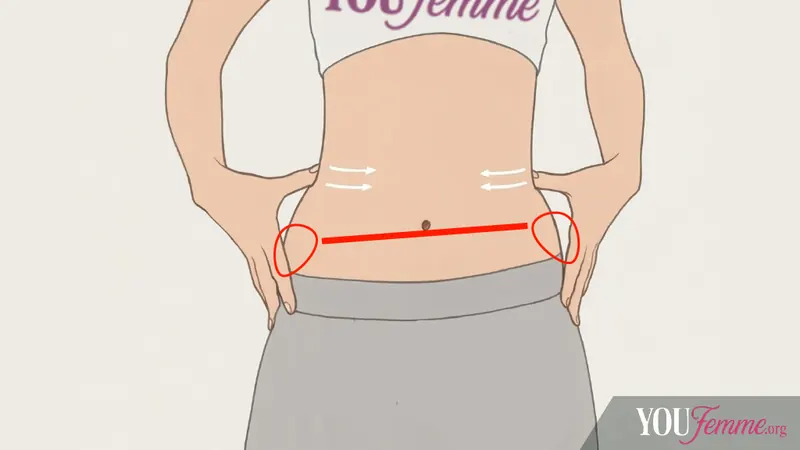
I. Hip Height Check
- Stand in front of a mirror wearing shorts or underwear.
- Place your hands on the top of your hip bones.
Does one hip sit higher than the other? Does one side feel more stressed than relaxed?
If yes, this signals:
- Tight quadratus lumborum on the high side
- Weak glute medius on the opposite side
- Leg length discrepancy (functional, not structural)

Release Tight Muscles That Pull Your Hips Out of Alignment
One hip becomes dominant when the muscles around it are too tight. Physiotherapists almost always begin with targeted releases before moving on to strengthening. If you skip this step, your imbalances will persist, no matter how hard you train.
1. The Quadratus Lumborum (QL)
This muscle hikes one hip upward.
Release it by:
- Sitting on the floor with one leg straight.
- Reaching your arm overhead and leaning sideways.
- Holding a deep stretch for 30 to 60 seconds per side.
2. The Tensor Fascia Latae (TFL)
This muscle pulls the hip outward, interfering with glute growth and symmetry.
Release with:
- Side-lying foam rolling
- The “figure 4 lean” stretch
- Pigeon pose with a forward fold
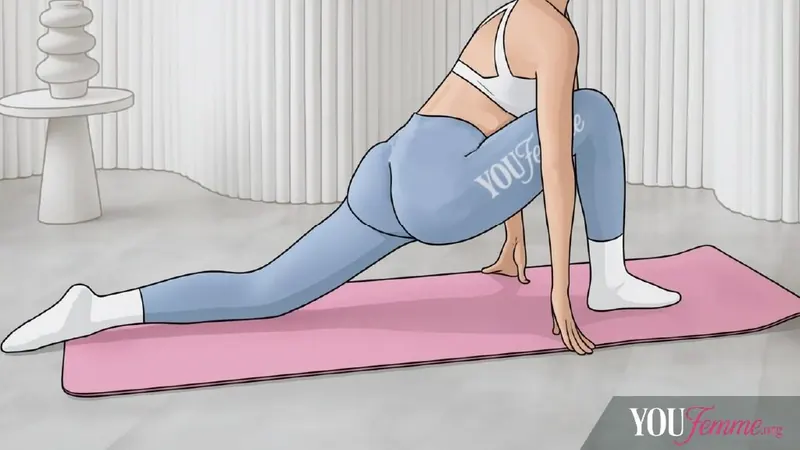
3. The Hip Flexors
If they’re tight on one side, your pelvis will twist.
Release it by:
Lunge stretches
Couch stretch
You should feel:
More even weight on both legs
Less pinching in one hip
Better range of motion on your tight side
Glutes activating more easily afterward

Strengthen the Glute Medius
Targeting your side glutes corrects the most common cause of pelvic asymmetry. Physiotherapists agree that a weak or poorly firing glute medius is the number one mechanical driver of an uneven pelvis. Activating this muscle properly changes how your pelvis sits and how your hips look aesthetically.
Start with neuromuscular exercises that emphasize slow contractions like:
1. Clamshell With Band - Lie on your side with knees bent and a light band above knees. Keep feet together and lift the top knee slowly, feeling the outer hip. Perform 3 sets of 12 to 15 reps. Pause for 2 seconds at the top on the weaker side.
2. Side-Lying Hip Abductions - Lie on your side and lift the top leg straight up without rotating the pelvis. Do 3 sets of 12 controlled reps; add an extra set on the weaker side.
3. Single-Leg Mini Squats With Focused Hip Drive - Stand on one leg, perform mini squats and intentionally push the hip out slightly to drive abduction. 3 sets of 8 to 10 reps each side.
Physiotherapists recommend doing isolated activation 4 to 6 times per week early on, keeping sets short and emphasis on control. When one side is weaker, do one extra set on that side or add 5 to 10 extra focused repetitions to the weaker side only.
You can use one of our curated guides to further develop your glutes: Beginner Glutes Workout Routine.
Train Single-Leg Strength
One of the ways to correct hip imbalances is by starting to use single-leg exercises to force each hip to "carry it weight" so to speak instead on relying on the stronger hip to do the whole carrying. This also serves as a great way to reveal hidden imbalances between each hip.
Bilateral exercises (two legs working together) can mask asymmetry because the stronger side dominates. Single-leg training exposes the weaker side and compels the nervous system to coordinate stability and force equally.
Some recommended exercises are:
1. Single-Leg Glute Bridge - Lie on your back and drive through one heel to lift hips. Perform 3 sets of 10 to 12 reps on each side. Add an extra set to the weaker side. Focus on smooth hip extension and pelvis level at the top.
2. Bulgarian Split Squat - Start with bodyweight, ensure the front foot is positioned so the knee tracks over the second toe. Perform 3 sets of 8 to 12 reps. Keep torso upright and feel the front glute working.
3. Single-Leg Deadlift (Hip Hinge) - Slow hinge on one leg focusing on a straight spine. Do 3 sets of 8 to 10 reps per side. This teaches hip extension control and balance.
For technique cues, also reference Best Glute Exercises For A Feminine Hourglass Shape.
Note
Single-leg strength helps the pelvis sit level by training the hip stabilizers to hold the pelvis steady during everyday activities, including walking and standing.

Maintain Symmetry With Daily Habits
Start locking in your gains by building daily habits and progressively increasing challenge in a balanced way. Symmetry is not a weekend fix; it’s a lifestyle pattern where daily practices reinforce balanced muscle use and joint alignment.
Create a maintenance plan:
- Daily 5-Minute Symmetry Habit: morning or evening: 20 side-lying abductions per side, 20 glute bridge pauses, and 15 banded lateral steps. This keeps neuromuscular awareness high.
- Monthly Reassessment: film squats and walking, re-do the single-leg stand test, and re-measure hip height. Adjust accordingly if a side seems to regress.
Community Q&A
Question
Can hip asymmetry be fixed fully without surgery?
Yes. Most asymmetry is functional and driven by muscle imbalances, tight tissues, and movement patterns. With consistent release, activation, single-leg strength, and gait re-education, many people achieve significant and lasting symmetry within 6 to 12 weeks.
Question
How much time should I spend daily on symmetry work?
Start with 5 to 15 minutes of activation and mobility daily, and two 30 to 40-minute single-leg strength sessions per week. Monthly reassessments help track progress.
Question
When should I see a physiotherapist in person?
If you experience sharp pain, numbness, or persistent weakness that does not improve with gentle routine work, consult a physiotherapist. Also seek in-person assessment if you have a history of hip surgery or structural leg length discrepancies.
Free PDF
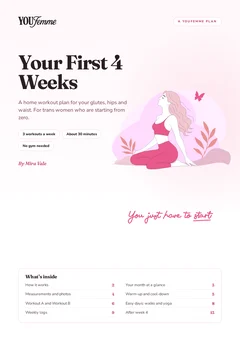
Want something to follow for the next month?
Three short workouts a week for your glutes, hips and waist, a couple of walks and a bit of yoga. Print it, stick it on your fridge and tick the boxes. We’ll also email you when a new guide goes up.
We only email you about YouFemme stuff, and you can leave whenever you want. Privacy
Done! We just sent you an email. Tap the button in it so we know it’s really you.
And here’s your plan:
Download the PDFThat didn’t go through. Is the email right?
Whoa, that’s a lot of tries. Give it a minute.


