How to Tuck Safely: A Step-by-Step Guide for Trans Women
Heads up: some links on this page are affiliate links. If you buy something through one, we may get a small cut, and it costs you nothing extra. We only link things we’d suggest anyway. How this works
Here's how to tuck in short: guide your testicles up into the two small canals just above them (or back and to the sides if you'd rather skip that), pull your penis and scrotum back between your legs, and hold it all in place with a gaff, snug underwear or skin-safe tape. It should never hurt. If it does, stop.
The details are where people get stuck, and where most of the safety lives: what to wear, how long you can stay tucked, what to do about peeing, sleeping and the gym, and which kind of pain means "take a break" versus "go to the ER".
One honest warning before we start. There isn't much research on tucking. A 2025 review found only seven studies on it, and three of those were single-patient case reports. So below, I'll tell you what the studies actually found, and where there's no study, what trans health clinics like Fenway Health and UCSF recommend.
In this guide
- What Tucking Involves
- Is Tucking Safe? What the Research Says
- Gaff, Underwear or Tape?
- What You'll Need
- How to Tuck, Step by Step
- How to Tuck With Tape
- How to Untuck
- How Long Can You Tuck?
- Sleeping, Exercise and Swimming
- Hygiene and Skin Care
- Tucking and Fertility
- Tucking Pain: When to Stop and When to See a Doctor
- Community Q&A
What Tucking Involves
Tucking means positioning your genitals so your crotch looks flat and smooth in clothes. Lots of girls do it to ease dysphoria, or just so they can wear leggings and swimsuits without thinking about it.
There are two parts, and you can do one or both:
The testicles. Just above where your testicles hang, one on each side, there's a short passage called the inguinal canal. It's where they came down from before you were born. With two or three fingers you can slide each one back up into it. This step is optional.
The penis and scrotum. These get pulled back between your legs, toward your bum, and held there by a gaff, underwear or tape.
You don't need dysphoria, a diagnosis or a plan for surgery to tuck. Fenway Health's guide says it plainly: it's for anyone with these body parts who wants a flatter look.
Is Tucking Safe? What the Research Says
For most people, tucking done carefully seems to cause mostly minor problems. But "seems" is doing a lot of work in that sentence, so here's what we actually know.
It's really common. In a 2024 study of 79 trans women and transfeminine people in the Baltimore area, three out of four had tucked. Most of them tucked every day, and almost half of those stayed tucked 17 hours a day or more.
Mild side effects are common too. In that same study, 27% of the girls who tucked had itching, 20% had a rash and 17% had testicle pain. About 41% reported no problems at all.
More hours, more problems. A second 2024 study of 98 patients at a Virginia clinic found 65% had at least one side effect, with testicle pain the most common at 32%. The longer people stayed tucked each day, the more likely they were to have side effects, and the authors singled out tucking for 8 or more hours a day.
People don't tell their doctors. In the Virginia study only 10% got medical care for their side effects, and just 23% had ever talked to a provider about tucking. Please be in the other group. Your doctor has heard weirder things, promise.
Serious problems are rare, and the evidence for them is weak. UCSF's clinical guidelines list possible urinary infections, testicle pain and, in theory, hernias near the canal. Testicular torsion (a twisted testicle) has been linked to tucking in two published case reports. That's two people, ever, in the medical literature, so it's rare. But torsion is an emergency, so the warning signs are further down.
Gaff, Underwear or Tape?
No method is the "right" one. Fenway's guide says it comes down to what works for your body. Here's how they compare.
Snug underwear. The easiest place to start. Tight briefs or shapewear can hold a tuck well, and you probably own something that works. In the Baltimore study, 63% of tuckers used tight panties or briefs.
A gaff. Compression underwear made for tucking, often with a firmer front panel. It was the most popular method in that study (73%), and it's easy to take off for the bathroom. A swimsuit bottom works as a stand-in in a pinch.
Tape. Holds everything very securely, which is why people use it under swimsuits or very tight clothes. The trade-off: you have to undo it every time you pee, it can irritate skin when used a lot, and clinics advise shorter wear times. If you're just starting, underwear or a gaff is the easier place to learn.
Lots of people layer, like a gaff over snug briefs. That's fine as long as the total doesn't get painfully tight.
What You'll Need
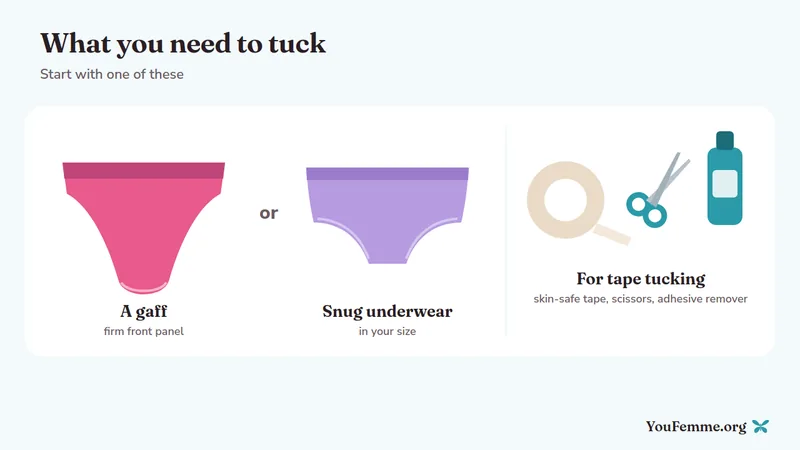
For a basic tuck, just a gaff or a pair of snug underwear in your size. Go by each brand's size chart, because one that's too small hurts and one that's too big won't hold anything.
For tape, add: skin-safe tape, scissors, and something to help it come off later (warm water works, medical adhesive remover is better).
Optional extras: a small piece of gauze or tissue, and an antifungal powder if you sweat a lot.
Can't afford a gaff? The nonprofit Point of Pride runs a free femme shapewear program that ships gaffs to trans women who can't afford or safely get one.
How to Tuck, Step by Step
This is the no-tape method, using a gaff or snug underwear. Do your first tries at home, when you're relaxed and not in a rush. Tucking takes practice, and your first few attempts will probably feel awkward. That's normal.
How to do it:
1. Use the bathroom first, then make sure the area is clean and dry
2. Step into your gaff or underwear and pull it up to just above your knees
3. Optional: with two or three fingers, slide one testicle up into its canal, just above and to the side of where it hangs, then do the other. Go slowly. If you feel pain, stop and try again another day
4. If you're skipping that step, move your testicles back and slightly to the sides instead
5. Keeping one hand in place, pull your penis and scrotum back between your legs toward your bum. Don't yank or force it
6. Still holding everything, pull your gaff or underwear up snugly
7. Walk around, sit down and bend over to check it stays put and nothing pinches
Some girls fold the loose scrotal skin around the penis before pulling it back, which gives a smoother result. Try it both ways and see what's comfier.
Snug is the goal. If anything pinches or throbs, it's too tight. A bit of strangeness at first is expected, pain isn't.
How to Tuck With Tape
Tape is the most secure option, and the one with the most ways to go wrong. A few rules first.
Never use duct, packing or Scotch tape. Every clinic guide agrees on this. These tapes rip skin and hair and cause rashes. Use tape made for skin.
Which skin-safe tape? Honestly, the guides disagree. Fenway says medical-grade tape, others suggest athletic tape, and Trans Lifeline prefers tape sold for tucking because medical tape can lose grip when wet. Whatever you pick, try a small strip on your thigh for a few hours first to make sure your skin is OK with it.
Never tape over broken, raw or irritated skin.
How to do it:
1. Trim or shave the area a day ahead if you can, so the tape doesn't pull hair. Freshly shaved skin is sensitive, so let it calm down first
2. Wash and towel-dry the area. No lotion or oil, or the tape won't stick
3. Pre-cut your strips. Fenway suggests starting with 2 to 3 pieces long enough to run from your lower belly to your tailbone
4. Tuck as in the steps above
5. Lay the strips from your lower belly, over the tucked shaft, between your legs and up toward your tailbone
6. If you need more hold, add a strip from the tucked area under each cheek and out to the hip
7. Pull on underwear or a gaff over the top for backup
Some people put a piece of soft cloth or paper over the most sensitive skin first so the tape isn't stuck right on it. It'll probably take a few tries to work out how many strips and what lengths suit you.
How to Untuck
Without tape, it's simple: pull your underwear down and use your hands to guide everything back to its resting position, slowly. Don't pull on the scrotum or the cord above the testicle to drag them out. In one of the torsion case reports, that's exactly how the patient untucked.
With tape, go slow. Peel it back carefully, holding the skin flat as you go. If it won't come off without hurting, soak in a warm shower or bath, or hold a wet, warm washcloth on it to loosen the glue. A medical adhesive remover helps a lot.
Then let your skin breathe for a while before you tuck again.
How Long Can You Tuck?
The honest answer is that no study has worked out a safe number of hours. What we have is one data point and some clinic rules of thumb.
The data point: in the Virginia study, the risk of side effects went up with the length of daily tucking, and people tucking 8 or more hours a day were flagged as more likely to have problems.
The rules of thumb:
Fenway Health says take a break every 8 to 12 hours.
Folx and WebMD say not to stay taped longer than about 4 to 8 hours.
Trans Lifeline says keep it to 8 hours or less, and try not to tuck every day.
UCSF suggests shorter or looser tucking if you get pain, and Rainbow Health Ontario suggests building breaks into your week.
So a sensible plan: start with short stretches at home and build up. Tuck when it matters to you, like when you're out, and untuck when you get home. Tape gets the shortest wear time. And if something starts to ache, that's your break, no matter what the clock says.
Sleeping, Exercise and Swimming
Sleeping. Don't sleep tucked. Both Fenway and WebMD say this. Night is the easiest time to give your body a long break, and you won't notice if something starts to hurt while you're asleep.
Exercise. There's no research on tucking during workouts, so this is practical advice. A gaff or snug sports briefs are easier at the gym than tape, since you can't redo tape halfway through a workout. Fenway lists overheating and dehydration as signs it's time to untuck, and you're more likely to hit both while training. Drink water, and change out of sweaty gear soon after. More on staying comfy during cardio in our curated guide: Running on HRT: What to Expect.
Swimming. A swimsuit bottom with a firm front, or a gaff underneath, is often enough. Point of Pride suggests a swimsuit bottom as a gaff stand-in anyway. If you tape for the beach, remember some tapes lose grip in water, so test yours in the shower first, and don't leave it on all day.
Hygiene and Skin Care
Where we tuck is warm and sweaty, and your urethra (where pee comes out) ends up pointing back toward your bum. That's probably why skin trouble is the most common side effect, and why some girls get urinary infections. One woman in the Virginia study said exactly that: she got a few UTIs because tucking brought those two openings close together.
A few habits help:
Cover the tip. Some people put a small piece of gauze or tissue over the tip of the penis before tucking, to keep germs from the bum away from the urethra. Fenway mentions this one.
Keep it dry. If you sweat a lot, an antifungal powder can help. Plain baby powder isn't antifungal, as Folx points out.
Check your skin. Look for broken, red or irritated spots before and after tucking. If you find any, give that skin a few days off, and skip tape completely until it's healed.
Wash your gear. Wash gaffs and tucking underwear after each wear. Breathable fabric for the layer against your skin is kinder than shiny synthetics.
Pee when you need to. Don't hold it in to avoid retucking.
Tucking and Fertility
If you might want biological kids one day, this section matters.
Tucking seems to lower sperm quality. In a Dutch study of 113 trans women who hadn't started hormones, those who tucked a lot had about 8 times higher odds of a very low motile sperm count, even after the researchers accounted for other factors. The study was small, so the exact number is shaky, but the direction lines up with the other research.
The good news: it looks reversible. Two case reports describe women whose sperm counts recovered about 3 months after they stopped tucking. A 2024 review concluded that taking a temporary break from tucking may improve sperm before freezing it.
Why it happens isn't proven. The leading idea is heat, since testicles normally sit outside the body to stay cooler, and tucking moves them in close. Nobody has actually measured the temperature during tucking yet, though.
Tucking Pain: When to Stop and When to See a Doctor
A bit of discomfort while you're learning is normal. Real pain isn't. Here's how to tell what to do.
Take a break if you notice soreness, tightness, itching, skin irritation, a dull ache, feeling overheated or needing to pee badly. Fenway lists all of these as signs it's time to untuck. If you feel faint or sick while tucked, untuck right away.
Book a doctor's appointment if:
Pain, aching, tingling or numbness carries on even after you've untucked.
It burns or hurts when you pee, or you get pain in your bladder or lower back.
There's blood in your pee, even a tiny bit. The NHS says get an urgent appointment for this, even if you're not sure it's blood.
You find a new lump or bulge in your groin.
Your skin is broken, weeping or looks infected.
Go to the emergency room now if:
You get sudden, severe pain in a testicle.
One side of your scrotum swells up, or a testicle sits higher than normal.
Testicle pain comes with nausea, vomiting or belly pain.
Testicle pain lasts more than an hour or keeps going while you rest.
These can be signs of torsion. MedlinePlus says that if surgery happens within 6 hours, most of the testicle can usually be saved, so don't sit on it out of embarrassment. Untuck, and go.
Community Q&A
Question
Do I have to push my testicles up to tuck?
No. It's optional. Fenway's guide says you can position them back and to the sides instead, as long as your gaff is wide enough to cover everything.
Question
What happens if I get an erection while tucked?
It shouldn't undo your tuck, but it can be uncomfortable, according to a New York clinic's tucking guide. If it hurts, untuck for a bit.
Question
Can I tuck every day?
Most people who tuck do. In the Baltimore study, 85% of tuckers did it daily. Clinics still recommend breaks, like untucking at night and giving yourself days off when you can.
Question
Can tucking cause a hernia?
It's possible in theory, and UCSF's guidelines mention it, but no study has measured it. If you notice a new bulge in your groin, see a doctor.
Question
Can I wear a gaff without tucking?
Yes. Fenway notes a gaff alone can flatten things a fair bit, which is a nice option for days you want a break.
Question
I'm a beginner and it keeps slipping. What am I doing wrong?
Probably nothing. Most girls need a few tries. Try a firmer gaff, layer it over snug briefs, or check your size. And practise at home before your first day out.
Was this guide helpful?
Thank you! That tells us what to write more of.
Got it, thank you. We read every note.

Free PDF
Want something to follow for the next month?
Three short workouts a week for your glutes, hips and waist, a couple of walks and a bit of yoga. Print it, stick it on your fridge and tick the boxes. We’ll also email you when a new guide goes up.
We only email you about YouFemme stuff, and you can leave whenever you want. Privacy
Done! We just sent you an email. Tap the button in it so we know it’s really you.
And here’s your plan:
Download the PDFThat didn’t go through. Is the email right?
Whoa, that’s a lot of tries. Give it a minute.