MTF Breast Development Timeline: Stages, Size and What's Normal
Heads up: some links on this page are affiliate links. If you buy something through one, we may get a small cut, and it costs you nothing extra. We only link things we’d suggest anyway. How this works
Here's the MTF breast development timeline in one go: buds usually show up somewhere between a few weeks and 6 months after you start HRT, the fastest growth happens in the first 6 months, and then things keep filling out slowly for 2 to 3 years, sometimes up to 5.
Size is where expectations and reality often don't match. In the best studies we have, most trans women were still under an A cup after 3 years. And most of them were happy with their breasts anyway, which surprised the researchers a bit too.
Below we go stage by stage, with what it feels like, what's normal, what changes your results and what's a waste of money. All the numbers come from real studies, and we'll tell you when the evidence is thin.
In this guide
- The MTF Breast Development Timeline, Month by Month
- Breast Growth Tanner Stages for Trans Women
- What Does MTF Breast Growth Feel Like?
- Uneven Breast Growth: Is It Normal?
- Nipple and Areola Changes
- How Big Will My Breasts Get on HRT?
- What Affects Your Results
- Does Progesterone Help Breast Growth?
- Myths That Waste Your Money
- Thinking About Breast Augmentation
- Breast Health and Screening
- Community Q&A
The MTF Breast Development Timeline, Month by Month
Think of this as a second puberty. Cis girls take years to develop, and you will too. Here's roughly how it goes.
First few weeks: Small, tender buds start forming under your nipples. UCSF's trans care team tells patients this usually happens "within a few weeks". The Endocrine Society guideline gives a wider start window of 3 to 6 months, so don't panic if you're on the later side.
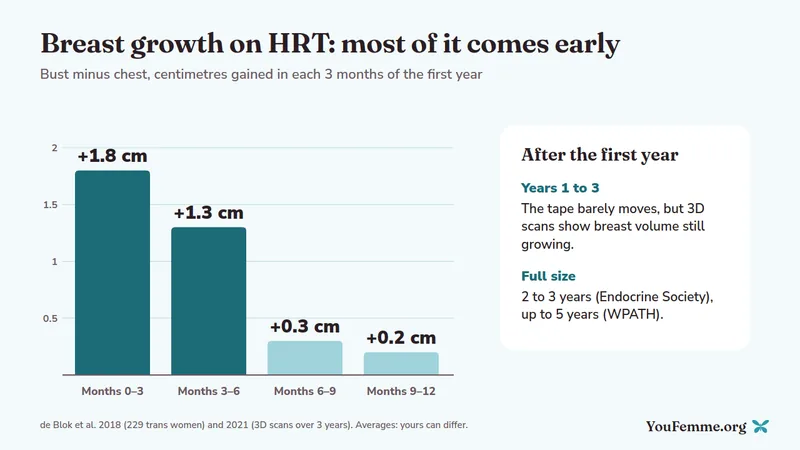
Months 0 to 6: This is the growth spurt. In a study of 229 trans women in the Netherlands, Belgium and Italy, the difference between bust and chest grew by about 1.8 cm in the first 3 months and another 1.3 cm in months 3 to 6. The researchers' own summary: main breast development happens in the first 6 months.
Months 6 to 12: It slows way down. Same study, only about 0.3 cm more in months 6 to 9 and 0.2 cm in months 9 to 12. This is when a lot of girls start asking "did it stop?"
Years 1 to 3: It hasn't stopped, it's just slower and harder to measure. A later Amsterdam study used 3D body scans on 69 trans women for 3 full years. The tape-measure number flattened out after about 9 months, but breast volume kept going up for the whole 3 years. The Endocrine Society puts the maximum at 2 to 3 years.
Year 3 and beyond: The WPATH Standards of Care (version 8) stretch the maximum out to 2 to 5 years. One group measured at about 4.5 years on hormones had a median breast volume of 115 mL.
Want the bigger picture of everything else changing alongside this? Check out our curated guide: MTF HRT Timeline: What Changes and When.
Breast Growth Tanner Stages for Trans Women
Tanner stages are the scale doctors use for breast development in puberty. They were written in 1969 for cis girls, but trans studies and clinics use them too, so they're the closest thing to official MTF breast growth stages.
Stage 1: Flat. Only the nipple sticks out.
Stage 2: The bud stage. The breast and nipple lift into a small mound, and the areola (the darker skin around the nipple) gets wider.
Stage 3: The breast and areola keep growing, and they still form one smooth shape together.
Stage 4: The areola and nipple puff out into their own little mound on top of the breast. This is the "puffy nipples" phase people ask about.
Stage 5: The mature shape. The areola settles back in line with the breast, and only the nipple sticks out.
So how far do trans women get? UCSF's guidelines say breast development usually reaches Tanner stage 2 or 3. WPATH says fewer than 20% reach stage 4 or 5 after 2 years of treatment.
What Does MTF Breast Growth Feel Like?
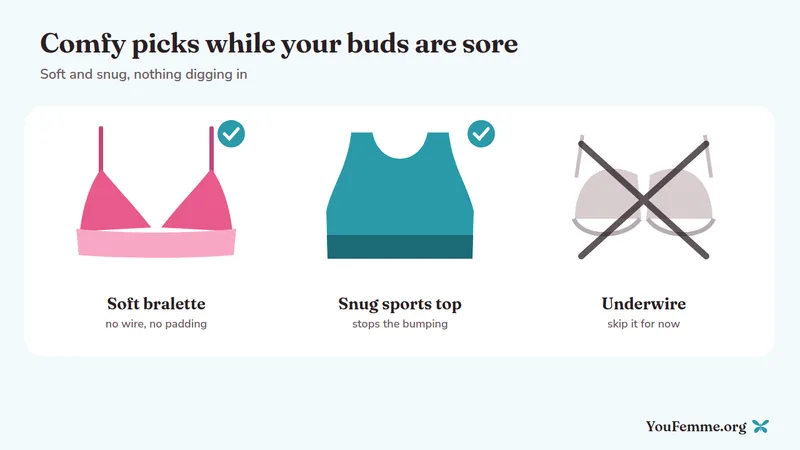
The first thing most girls notice is a small bump right under the nipple. That's the bud, and it's usually sore, especially when something touches it.
Sore is normal. In a European study that followed trans women through their first year, breast tenderness went up significantly. UCSF describes the buds as "slightly painful, especially to the touch", and says the pain "will diminish significantly over the course of several months". Their screening guide also mentions that early development can feel lumpy, which they call nodularity.
Hugs, seatbelts, sleeping on your front, a cat jumping on your chest... yeah. You'll feel all of it for a while.
Uneven Breast Growth: Is It Normal?
Yes. UCSF's patient guide says it plainly: during bud growth "the right and left side may be uneven", and that's the normal course of development. It also points out that, as with all women, trans women's breasts vary in size and shape and are sometimes uneven with each other.
Will uneven breast growth even out? Honestly, nobody knows for sure. We couldn't find a single study that measured left vs right in trans women over time. Many cis women end up a little uneven too, so a small difference that stays is just part of having breasts.
Nipple and Areola Changes
Your nipples and areolas change too, and it's part of the Tanner stages above. In stage 2 the areola widens. If you get to stage 4, the areola and nipple form that puffy little mound before (sometimes) flattening out in stage 5.
They also move. In the 3-year Amsterdam study, the distance from the base of the neck to each nipple grew by 1.3 cm on average, and the distance between the nipples grew by 1.0 cm. That's the breast filling out underneath them.
Some girls and doctors say progesterone helps the areola develop. UCSF lists that as an anecdotal report, and no study has tested it. More on progesterone below.
How Big Will My Breasts Get on HRT?
This is the part most guides tiptoe around, so here are the real numbers.
After 1 year: In that 229-woman study, 48.7% were smaller than an AAA cup, 26.4% were AAA, 14.2% were AA, 7.1% were an A and only 3.6% were bigger than an A.
After 3 years: In the 3D study, breast volume went up by 72 cc on average, to about 100 cc per breast. 71% were still under an A cup.
After about 4.5 years: The median was 115 mL, still under an A cup.
UCSF tells patients that most trans women who start after puberty can expect "an 'A' cup or perhaps a small 'B' cup", even after many years. That's a bit more generous than the Dutch measurements. Part of the gap is probably how size was measured: the studies used tape measures and 3D scans, not bra fittings.
And here's the good news. At least 58% were satisfied with their size at 3 years, and 68% at around 4.5 years.
What Affects Your Results
Short version: HRT breast growth depends less on your prescription than you'd hope, and the things people obsess over seem to matter the least.
Testosterone suppression. This one seems to matter. In a German clinic of 155 trans women, higher testosterone went with a lower Tanner stage. UCSF's view is that "the primary predictor of feminizing effects is likely the lack of testosterone rather than levels of estrogen".
Estrogen levels. In the 229-woman study, women in the lowest and highest estradiol groups grew about the same (3.6 cm vs 3.6 cm after a year). The German clinic also found estradiol had no significant effect. Your doctor still needs your levels in a normal female range, but pushing them higher doesn't seem to buy you more growth.
Patches, pills or shots. Patches gave faster growth in the first 6 months in the big study, but by 12 months there was no difference. Another Amsterdam study found similar 12-month volume gains for patches (69 mL) and pills (62 mL). UCSF says there's no evidence injections lead to more or faster feminization.
Age. In the 1-year study, age made no difference. UCSF does note that starting in your 40s, 50s or later may bring less dramatic changes overall. And starting very young doesn't guarantee more: girls who blocked puberty early ended up with about the same volume as women who started as adults.
Body fat. Women with obesity grew faster in the first 6 months, but caught up to everyone else by 12 months. Gaining or losing weight during the year made no difference either. If you're curious where the rest of your fat goes on HRT, check out our curated guide: Fat Redistribution on HRT: Where It Goes and How to Help It.
Genetics. Everyone assumes this is the big one, and UCSF lists it first. But to be fair, no study has actually tested it in trans women yet.
Does Progesterone Help Breast Growth?
Maybe, maybe not. Right now there's no good evidence either way, and anyone who tells you it's proven (in either direction) is overselling.
The case for it: progesterone plays a role in breast development in cis puberty, and one well-known 2019 paper argued it could help trans women reach Tanner stages 4 to 5. That paper is an expert opinion, not a trial.
The case against "it definitely works": A 2022 systematic review found no conclusive evidence it improves breast development. A small Australian study gave progesterone to 23 people and compared them with 19 who didn't take it, and saw no difference in Tanner stage after 3 months (which is a short time, to be fair).
What users say: In a 2025 US survey of 543 people, 80% of progesterone users felt it improved their breasts. But that's how people felt, nobody measured anything. 29% also reported breast pain and 22% mood swings.
What the guidelines say: WPATH says there's currently not enough evidence that the benefits outweigh the risks. The same 2022 review linked progestogens to lower HDL ("good") cholesterol and a higher risk of blood clots.
The real answers are coming. Two randomised trials are underway, one in Amsterdam measuring breast volume with 3D scans, one in the US with a placebo group. Until they report, talk it through with your doctor before trying it.
Myths That Waste Your Money
Breast growth is a huge market, and most of it is selling hope.
Herbal "bust" supplements. A review of these products found zero clinical trials. Some of the herbs are hormonally active, and some products contain grains that can carry a fungus which makes a strong estrogen, so the review recommended people avoid them. "Natural" doesn't mean safe, especially when you're already on hormones.
Higher doses or DIY hormones. UCSF is clear: higher doses won't bring faster or bigger changes, but they can bring more side effects. A UK clinic even found that women who'd self-medicated with estrogen were more likely to ask for breast surgery later (11.5% vs 6%). That doesn't prove DIY caused it, but it definitely didn't help.
Pumps and suction bras. There's one small study from 2000 where 12 cis women wore a medical suction device for 10 to 12 hours a day, every day, for 10 weeks, and kept part of the gain. It had no comparison group and no trans women in it. The cheap pumps sold online have never been tested at all.
Massage. We looked, and there's no study showing massage grows breasts in anyone. If it feels nice, enjoy it. Just don't expect a cup size.
Thinking About Breast Augmentation
Plenty of trans women look into implants at some point, and the advice is to wait until your natural growth has had its chance.
The Endocrine Society says to wait at least 2 years on estrogen. WPATH's version 8 dropped the fixed wait for adults: it suggests being stable on hormones (which may mean at least 6 months, or longer if needed for a good result), and names breast growth and skin stretching as reasons to wait longer. UCSF tells patients to wait at least a year.
In a survey of 773 trans women in Amsterdam, those who got implants had them a median of 2 years after starting hormones, and 80% were happy with the result. About a third reported health complaints they blamed on the implants, and money was the main thing stopping others. Augmentation also became less common over time, from 70% of women who started hormones in 1980 to 2000, down to 20% of those who started in 2010 to 2015.
Training your glutes and hips changes how your whole silhouette reads, chest included. Check out our curated guide: How to Build Feminine Curves as a Transgender Woman.
Breast Health and Screening
Real breasts mean real breast health, so a quick word on cancer. In a Dutch study of 2,260 trans women, breast cancer was 46 times more common than in cis men, but still lower than in cis women. That works out to 15 cases, mostly after many years on hormones (median 18).
What that means for you: the Endocrine Society and WPATH both say to follow the breast screening guidelines for cis women, and WPATH adds that your age and years on hormones should be taken into account. UCSF suggests a mammogram every 2 years once you're 50 or older and have had at least 5 to 10 years on hormones. Guidelines differ, so ask your doctor what applies where you live.
Community Q&A
Question
When does breast growth start MTF?
Usually somewhere between a few weeks and 6 months after starting HRT. UCSF says buds often appear within a few weeks, while the Endocrine Society gives 3 to 6 months. If nothing at all has happened by 6 months, ask your doctor to check your testosterone and estradiol levels.
Question
My growth stalled around 6 to 9 months. Did it stop?
Probably not. The fast phase is mostly the first 6 months, and tape-measure growth tends to flatten around 9 months. But 3D scans showed volume kept rising for 3 years.
Question
Will uneven breast growth even out?
Sometimes, but there's no research on how often. Uneven growth is normal during development, and many cis women stay slightly uneven too.
Question
Is breast growth on HRT permanent?
Mostly yes. WPATH lists breast development as a permanent change, and UCSF says some breast growth isn't reversible if you stop hormones.
Question
Do higher estrogen levels mean bigger breasts?
Not according to the research. Two studies found estradiol levels didn't predict breast growth. Keeping testosterone low seems to matter more.
Question
What are puffy nipples on HRT?
It's Tanner stage 4, when the areola and nipple form their own little mound. It's a normal stage of development, and it can flatten later.
Was this guide helpful?
Thank you! That tells us what to write more of.
Got it, thank you. We read every note.
Free PDF
Want something to follow for the next month?
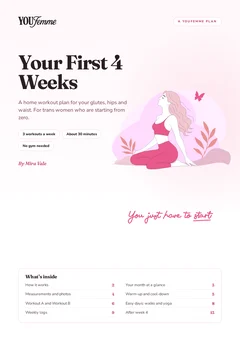
Three short workouts a week for your glutes, hips and waist, a couple of walks and a bit of yoga. Print it, stick it on your fridge and tick the boxes. We’ll also email you when a new guide goes up.
We only email you about YouFemme stuff, and you can leave whenever you want. Privacy
Done! We just sent you an email. Tap the button in it so we know it’s really you.
And here’s your plan:
Download the PDFThat didn’t go through. Is the email right?
Whoa, that’s a lot of tries. Give it a minute.