Voice Resonance Exercises for Trans Women: A Step-by-Step Guide
Heads up: some links on this page are affiliate links. If you buy something through one, we may get a small cut, and it costs you nothing extra. We only link things we’d suggest anyway. How this works
You've raised your pitch, you hit the numbers on the pitch checker... and you still get "sir" on the phone. Sound familiar?
That's usually not a pitch problem. It's resonance. Pitch is how high your voice is. Resonance is how big or small it sounds, and it's the part most people skip because nobody explains it properly.
So let's fix that. This guide covers what resonance actually is, what the research says about it, and a step-by-step way to train it at home without hurting your voice.
In this guide
- Pitch, Resonance and Weight
- What the Research Says
- The Three Things You Can Move
- Bright, Not Tight
- Step 1: Find It in a Whisper
- Step 2: Shape Your Mouth
- Step 3: Add Your Voice
- Step 4: Hold Your Pitch, Move the Brightness
- Step 5: Take It Into Real Conversations
- How Long It Takes
- When to See a Voice Therapist
- Community Q&A
Pitch, Resonance and Weight
People mix these three up all the time, so let's split them apart first.
Pitch: how fast your vocal folds vibrate, measured in hertz (Hz). It's the "high or low" of your voice, and it's the only thing a pitch checker measures.
Resonance: how your throat and mouth shape that sound. A longer, wider tube sounds darker and bigger. A shorter, smaller one sounds brighter and smaller. Think of the same note played on a cello and on a violin.
Weight: how thick or buzzy the sound is at the source. A heavy voice sounds full and "chesty", a light one sounds softer. It's not resonance, even though lots of guides lump them together.
What the Research Says
Here's the honest version, because a lot of guides get this wrong in both directions.
Pitch is the biggest single cue. A review of 38 studies found speaking pitch explained about 42% of how listeners judged a speaker's gender. So no, pitch isn't "unimportant".
But pitch alone usually isn't enough. In one experiment, researchers took real recordings and shifted them with a computer. Changing pitch AND resonance together made listeners hear the other sex about 82% of the time. Changing only one of them mostly didn't work.
Resonance matters more than older studies thought. A 2021 study of 379 speakers found that one resonance frequency (called F2, mostly controlled by your tongue and lips) was one of only two things that predicted whether listeners heard a man or a woman. The other was pitch.
And resonance matters most when your pitch is in the middle. When pitch sat between about 145 and 165 Hz, resonance was what tipped listeners one way or the other. That's great news if pushing your pitch high feels strained or fake: brighter resonance lets a comfortable, medium pitch sound feminine.
The Three Things You Can Move
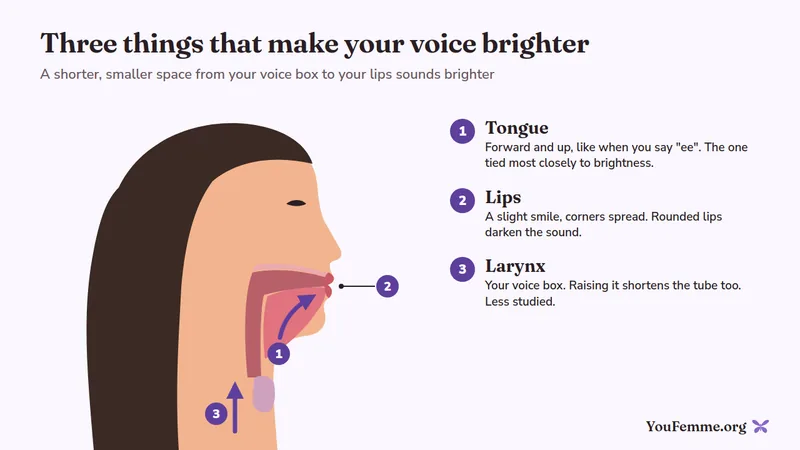
To make your voice sound smaller and brighter, you make the space inside your throat and mouth shorter and smaller. You have three main controls:
Your tongue. Pushing it forward and up, like when you say "ee", brightens the sound. This is the one tied most closely to F2.
Your lips. A slight smile, with the corners of your mouth spread a little, shortens the tube. Rounding or pushing your lips forward does the opposite and darkens the sound.
Your larynx. That's your voice box, the bump in your throat. Raising it shortens the tube too. It's super popular in the trans voice community, but honestly it has been studied much less than the other two.
The tongue and lip combo is the one with clinical research behind it. In a 2007 study, 5 sessions of training lip spreading and a forward tongue raised resonance, and most of the women were rated as sounding more feminine afterwards.
Bright, Not Tight
Before the exercises, one rule: bright should never mean squeezed.
Resonance work should feel light and easy. If your throat feels tight, your neck tenses up or your voice gets scratchy, you're pushing. Back off, take a break and drink some water.
Self-training without guidance can build bad habits, and some people end up with real voice problems like muscle tension or nodules. That's not meant to scare you off. It just means you go slow and listen to your body.
Step 1: Find It in a Whisper
Whispering lets you feel resonance without using your vocal folds at all, so there's no strain risk. This one is called Big Dog, Small Dog in the trans voice community.
How to do it:
1. Pant like a big dog, slow and deep, mouth open
2. Now pant like a medium dog, then a small dog, then a tiny one
3. Notice the sound getting brighter and smaller each time
4. Keep it relaxed and airy, your throat should never close up
5. Go back and forth between big and small until you can find "small dog" on purpose
The feeling you're after: the space inside your mouth getting smaller, and your voice box sitting a little higher. That's your resonance moving.
Step 2: Shape Your Mouth
Now add the two research-backed controls on purpose.
How to do it:
1. Say a long, whispered "eeee"
2. Let your lips spread into a slight smile
3. Feel your tongue pressing forward and up, close to the roof of your mouth
4. Keep your jaw loose, don't clench
5. Now whisper "hello", "hi there" and "see you" while keeping that smiley, forward shape
Don't overdo the smile. You're not posing for a selfie, just letting the corners of your mouth relax outward.
Step 3: Add Your Voice

Time to use your real voice, but keep your pitch the same the whole time. Pick a pitch that feels comfortable, not your highest.
How to do it:
1. Say "wa" in your normal voice
2. Say it again in the small dog shape from Step 1, same pitch
3. Then once in a big dog shape, same pitch
4. Do the same with single words: "hi", "apple", "yes", "really"
5. Each word three ways: normal, dark, bright, with a pause between them
The most common mistake here is letting your pitch climb when the sound gets brighter. They're linked, so it's totally normal at first. The next step fixes it.
Step 4: Hold Your Pitch, Move the Brightness
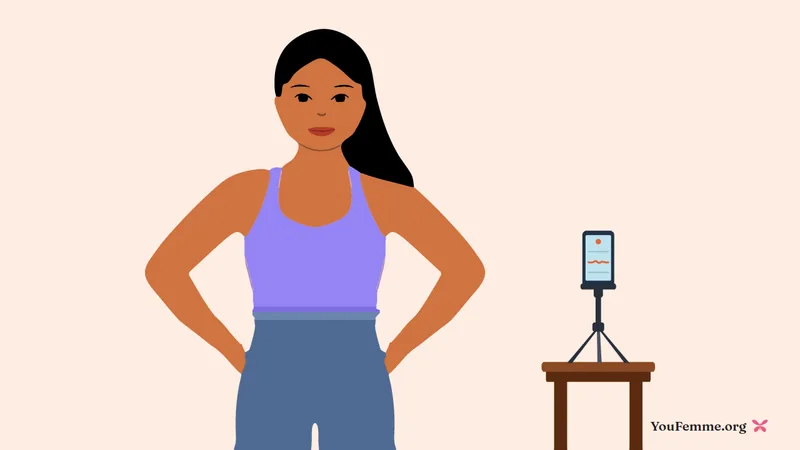
This is where our free Voice Pitch Checker comes in handy. Your goal is to change resonance while the pitch line stays flat.
How to do it:
1. Open the pitch checker and start it
2. Say a long "aaah" at a comfortable pitch and watch the number
3. Without moving the pitch, slowly make the sound brighter, like you're sliding from big dog to small dog
4. Then slide back darker
5. If the pitch number jumps, slow down and try again
When you can make the sound brighter while the number stays put, you've separated resonance from pitch. That's huge. It means you can now control each one on its own.
Step 5: Take It Into Real Conversations
This is the hardest part, and the research backs that up. In a 2023 trial, women's pitch rose about 49 Hz when reading aloud, but only about 29 Hz in spontaneous speech. Reading is easy. Talking while thinking is hard.
So practise in stages:
How to do it:
1. Short phrases: "Thanks so much", "Can I get a latte?", "Hi, it's me"
2. Reading out loud: a page of a book or an article
3. Describing something: what you did today, out loud, to nobody
4. Low-pressure real talk: a drive-thru, a call to a friend who knows
5. Everyday conversation
Record yourself at each stage. You hear your own voice through your bones, which makes it sound deeper to you than it really is. A recording is the only honest way to check.
How Long It Takes
Honest answer: weeks to months, and it's different for everyone.
In clinical studies, programs with resonance work ran about 5 to 12 sessions, and people showed measurable changes. In the biggest study, with 74 trans women, everyone was rated as sounding more female after training, though not all by a big amount. About two thirds got a real boost in how happy they were with their voice.
And it mostly sticks. Most of the gains held a year later, but pitch in reading slipped a bit for some women (from 169 to 153 Hz on average). So keep practising after things click.
When to See a Voice Therapist
You can absolutely start on your own. But a speech-language pathologist (SLP) who does gender-affirming voice work can hear things you can't, and catch strain early.
Look for one if: your voice gets tired or hoarse a lot, you've been practising for months and feel stuck, or you just want someone in your corner.
Search for "gender-affirming voice therapy" plus your city, or look for one who does online sessions. The American Speech-Language-Hearing Association says online therapy can work well, so you're not limited to your area.
Community Q&A
Question
Will HRT make my voice higher?
No. Estrogen doesn't change a trans woman's voice once it has dropped in puberty. Voice training is the way to change it.
Question
Do I need a really high pitch?
Not necessarily. Research found that resonance matters most when pitch is in the middle range (about 145 to 165 Hz). Bright resonance with a comfortable pitch often sounds more natural than a very high pitch with a dark sound.
Question
Can I measure my resonance?
Kind of. The free program Praat can show your formants (the resonance frequencies). On a held "ee" sound, women in one big US study averaged an F2 around 2,760 Hz and men around 2,320 Hz, but the ranges overlap a lot. Compare yourself to your own past recordings, not to a number.
Question
My throat hurts after practising. Is that normal?
No. A little tiredness can happen, but pain isn't part of it. Stop, rest your voice, drink water, and go lighter next time. If you stay hoarse for 4 weeks, see an ENT.
Was this guide helpful?
Thank you! That tells us what to write more of.
Got it, thank you. We read every note.

Free PDF
Want something to follow for the next month?
Three short workouts a week for your glutes, hips and waist, a couple of walks and a bit of yoga. Print it, stick it on your fridge and tick the boxes. We’ll also email you when a new guide goes up.
We only email you about YouFemme stuff, and you can leave whenever you want. Privacy
Done! We just sent you an email. Tap the button in it so we know it’s really you.
And here’s your plan:
Download the PDFThat didn’t go through. Is the email right?
Whoa, that’s a lot of tries. Give it a minute.